Complex dynamical systems often operate across organisational scales. In biology that hierarchy may run molecular → cellular → tissue → organ → organism → population; analogous nestings appear in climate (local convection → regional circulation), cities (agents → neighbourhoods → metro regions), and engineered systems (components → modules → plant). Mechanisms at one scale produce emergent behaviours at another.
A complete causal dynamical model (CDM) must sometimes bridge those scales. A drug effect measured in cell culture (micro) may need to predict organism-level response (macro); a controller tuned on a subsystem may fail when coupled into a plant. Without a principled framework for cross-scale reasoning, we cannot say when causal conclusions at one scale transport to another.
Multi-scale modelling asks: when do causal structures at one level of description imply or constrain causal structures at another? The micro-scale captures finer-grained mechanisms; the macro-scale captures coarser patterns (often defined by aggregation or coarse-graining).
In process terms (Chapter 9), micro occasions concresce locally; macro variables often describe a society, a defining characteristic (e.g. tissue mean, organ load) that endures across many micro steps. Cross-scale transport asks when that society-type persists.
20.2 Hierarchical State-Space Models
We extend the state-space models of Chapter 12 to multiple nested scales. A hierarchical SSM couples latent states at different timescales and resolutions.
20.2.1 Slow/Fast Decomposition
A natural decomposition separates macro-level (slow) states \(X^{(M)}_t\) from micro-level (fast) states \(X^{(m)}_t\). The macro state evolves on a slower timescale and may depend on aggregated micro-level information; the micro state evolves faster and is modulated by the macro context.
Observations may arise from either or both scales, depending on the measurement protocol.
20.2.3 Partial pooling across units (Turing)
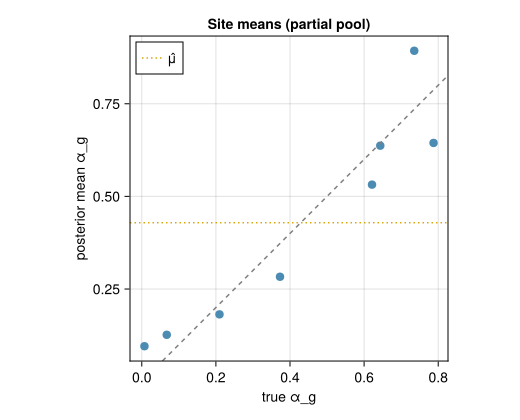
Multi-scale structure also appears as many units, shared hyperparameters: site-specific means drawn from a population distribution (partial pooling). That is the hierarchical bridge between “organism” and “population” when each site is a replicate CDM. A Turing random-intercept model is enough to show the idea quickly:
include(joinpath(dirname(Base.active_project()), "scripts", "book_bootstrap.jl"))@auto_using CairoMakie RandomStatisticsusingTuring: Turing, @model, sample, NUTS, filldistusingDistributionsRandom.seed!(15)G =8# sites (macro units)n_g =12# assays per siteμ_pop =0.4σ_site =0.35σ_obs =0.5site =vcat([fill(g, n_g) for g in1:G]...)α_true = μ_pop .+ σ_site .*randn(G)y = [α_true[site[i]] + σ_obs *randn() for i ineachindex(site)]Turing.@modelfunctionpartial_pool(y, site, G) μ ~Normal(0, 2) τ ~truncated(Normal(0.5, 0.5); lower =0.05) # site sd σ ~truncated(Normal(0.5, 0.5); lower =0.05) α ~filldist(Normal(μ, τ), G)for i ineachindex(y) y[i] ~Normal(α[site[i]], σ)endendt_pp =@elapsedbeginglobal ch_pp =sample(partial_pool(y, site, G), NUTS(0.8), 400; progress =false)endα_draws =vec(Array(ch_pp[:α])) # Vector{<:AbstractVector} of site vectorsα_hat =mean(α_draws)println("Partial pooling: population μ≈", round(mean(ch_pp[:μ]); digits =3)," (true ", μ_pop, "); ", round(t_pp; digits =3), " s")
Partial pooling: population μ≈0.429 (true 0.4); 5.698 s
Site means: truth versus partial-pool posterior means. Shrinkage toward the population mean is the hierarchical signature.
Complete pooling would force a single \(\alpha\); no pooling would fit each site in isolation. Partial pooling is the multiscale compromise: information flows from the population (macro) into each site (micro) through the shared prior.
20.2.4 Two-Scale Linear-Gaussian Example
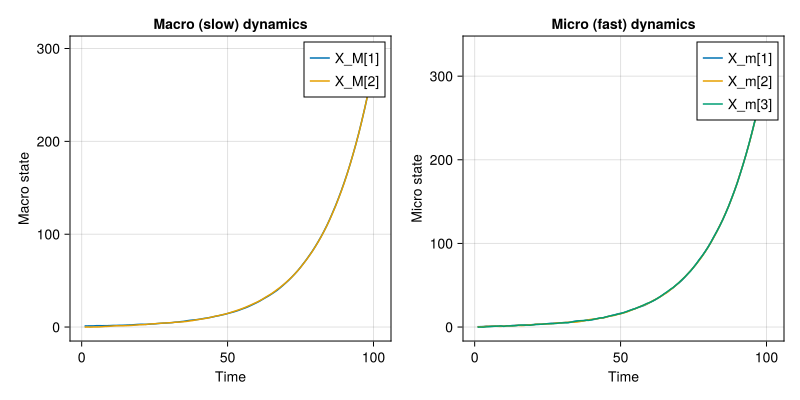
The following Julia code illustrates the structure of a two-scale Gaussian Linear Dynamical System (GLDS). The macro level has slow dynamics; the micro level has fast dynamics modulated by the macro state.
Two-scale GLDS: macro (slow) and micro (fast) latent states over time
20.3 Coarse-Graining and Emergence
When does a micro-level causal structure imply a macro-level causal structure? This question connects to renormalisation group ideas in physics: as we coarse-grain, what information is lost and what effective theory remains?
20.3.1 Coarse-Graining Operators
A coarse-graining map\(\phi: \mathcal{X}^{(m)} \to \mathcal{X}^{(M)}\) projects micro-level states to macro-level states. Common choices include:
Aggregation: Sum or count over micro units (e.g., total cell count)
Projection: Linear or nonlinear projection onto a lower-dimensional subspace
Sufficient statistics: Moments, order parameters, or other statistics that capture macro-relevant information
20.3.2 Causal Consistency
For the coarse-grained model to preserve causal semantics, the map \(\phi\) must commute with the do-operator in an appropriate sense. Formally, if we intervene on macro variable \(X^{(M)}_j\) in the macro model, the result should be consistent with intervening on the corresponding micro variables and then coarse-graining:
This holds when \(\phi\) is a sufficient statistic for the macro dynamics and when no macro-relevant information is lost. In practice, it often fails: coarse-graining typically loses information, and the macro causal structure may differ from a simple projection of the micro structure.
20.3.3 Information Loss and Effective Theories
Coarse-graining entails information loss. The macro model is an effective theory, valid for certain questions at the macro scale, but not a complete description. The renormalisation group teaches us that effective theories can be causally consistent for a range of scales and questions, even when the full micro structure is unknown.
20.4 Cross-Scale Transportability
Transportability asks: when can causal conclusions from one domain be transferred to another? (See Chapter 8 on transportability.) Cross-scale transportability extends this to scales: when can causal conclusions at the micro scale be transported to the macro scale (or vice versa)?
20.4.1 Cross-Scale Selection Diagrams
We extend Pearl’s selection diagrams to include scale variables\(S\) that indicate which scale we observe or intervene at. Edges from \(S\) to a variable indicate that the mechanism for that variable differs across scales. For example, \(S \to Y\) means the observation process differs (we might observe \(Y^{(m)}\) in cells vs \(Y^{(M)}\) in organisms).
20.4.2 Formal Conditions for Cross-Scale Identifiability
A causal effect \(P(Y^{(M)} \mid \text{do}(A^{(M)}))\) is cross-scale identifiable from micro-level data and assumptions when:
The effect can be expressed in terms of micro-level mechanisms and the coarse-graining map \(\phi\)
No unobserved confounding between scale-specific variables
The observation/intervention protocols at each scale are encoded in the graph
20.4.3 Example: Drug Effect from Cells to Organisms
A drug effect measured in cell culture (\(A^{(m)} \to Y^{(m)}\)) may or may not transport to organism-level outcome (\(A^{(M)} \to Y^{(M)}\)). Transportability requires:
The cellular mechanism is invariant (or its variation is modelled)
The coarse-graining from cellular response to organism response is known or identifiable
No scale-specific confounders (e.g., organism-level factors that affect outcome but not cell-level measurements)
20.5 Practical Implementation
20.5.1 Building a Two-Scale SSM Structure
The following code defines a struct representing the two-scale SSM and shows how to organise parameters for simulation.
20.5.2 Coarse-Graining a Micro-Level DAG to Macro-Level
We can represent coarse-graining of a causal graph: micro nodes aggregate into macro nodes, and edges are preserved when the corresponding macro-level influence exists.
# Coarse-graining: map micro DAG to macro DAG# Micro: A1→B1, A2→B2, A1→A2 (3 nodes each in two groups)# Macro: A→B with A = {A1,A2}, B = {B1,B2}project_root =let current =pwd()while !isfile(joinpath(current, "Project.toml")) && !isfile(joinpath(current, "_quarto.yml")) parent =dirname(current) parent == current &&break current = parentend currentendinclude(joinpath(project_root, "scripts", "ensure_packages.jl"))@auto_using Graphs# Micro-level DAGg_micro =SimpleDiGraph(6)# Group 1: A1(1), B1(2); Group 2: A2(3), B2(4); cross-group A1(1)→A2(3)add_edge!(g_micro, 1, 2) # A1 → B1add_edge!(g_micro, 3, 4) # A2 → B2add_edge!(g_micro, 1, 3) # A1 → A2# Partition: {1,3} → macro A, {2,4} → macro Bpartition = [[1, 3], [2, 4]]# Macro graph: edge A→B exists if any micro edge from group 1 to group 2g_macro =SimpleDiGraph(2)has_edge_1_to_2 =any(has_edge(g_micro, i, j) for i in partition[1], j in partition[2])if has_edge_1_to_2add_edge!(g_macro, 1, 2)endprintln("Micro graph: ", ne(g_micro), " edges")println("Macro graph: ", ne(g_macro), " edges (A→B)")
We sketch a function that checks whether a causal effect is identifiable across scales given a graph encoding scale-specific mechanisms.
# Check cross-scale transportability: can we express P(Y_M | do(A_M)) from micro data?# Simplified: check if there exists a path from A to Y that doesn't go through scale-specific confoundersusingGraphsfunctionhas_causal_path(g, src, dst)# BFS for directed path from src to dst visited =falses(nv(g)) queue = [src] visited[src] =truewhile !isempty(queue) v =popfirst!(queue)for w inoutneighbors(g, v) w == dst &&returntrueif !visited[w] visited[w] =truepush!(queue, w)endendendfalseend# Example: macro graph A → M → Y, with S (scale) → Y (observation differs by scale)g =SimpleDiGraph(4) # A=1, M=2, Y=3, S=4add_edge!(g, 1, 2)add_edge!(g, 2, 3)add_edge!(g, 4, 3) # S affects Y mechanism# Transportability: need to block S when estimating A→Y# If S is observed, we can adjust; otherwise not transportableprintln("A→Y path exists: ", has_causal_path(g, 1, 3))println("S→Y edge (scale affects outcome): present - adjustment for S required for transportability")
A→Y path exists: true
S→Y edge (scale affects outcome): present - adjustment for S required for transportability
20.6 Connection to Structural, Dynamical, and Observable Layers
Multi-scale modelling touches all three layers at each scale:
20.6.1 Structural Layer
Multi-scale DAGs with cross-scale edges encode which macro variables influence which micro variables (top-down) and how micro variables aggregate to influence macro variables (bottom-up). Coarse-graining corresponds to moving from a finer structural description to a coarser one, while preserving causal semantics when the coarse-graining map commutes with intervention.
20.6.2 Dynamical Layer
Hierarchical SSMs provide the dynamical counterpart: scale-specific transition functions \(f^{(M)}\) and \(f^{(m)}\) with cross-scale coupling. The macro dynamics \(f^{(M)}\) depend on an aggregation of micro states; the micro dynamics \(f^{(m)}\) depend on the macro state. Timescale separation (slow/fast) reflects different rates of change at different scales.
20.6.3 Observable Layer
Measurements at different scales correspond to different observation functions \(h\). Cell-level assays observe \(Y^{(m)}\); organism-level outcomes observe \(Y^{(M)}\). The observation model \(Y_t = h(X^{(M)}_t, X^{(m)}_t) + v_t\) may mix both scales when measurements aggregate (e.g., tissue biopsy averaging over cells).
Multi-scale modelling then adds a further question: when we coarse-grain or transport causal claims, how do these layers align across scales?