21Counterfactual Dynamics: Alternative Trajectories
Status: Draft
v0.4
21.1 Introduction
This chapter explores counterfactual reasoning in dynamical systems: alternative concrescences for the same organism (fixed creative advance\(\mathbf{u}\)) under different interventions on \(A_t\) (Chapter 9). This is Imagining in the Dynamical stratum: alternative trajectories of \(\mu_{1:T}\), not population averages.
21.2 Counterfactual Trajectories in Dynamical Systems
21.2.1 Definition
For a fixed exogenous realisation \(\mathbf{u}\), the counterfactual trajectory under intervention \(\iota\) in a dynamical system is:
\[
Y^{\iota}_{1:T}(\mathbf{u})
\]
Interpretation: Same organism (same creative advance \(\mathbf{u}\)), different intervention on \(a\), same society\((f, h, G)\).
21.2.2 Key Requirement
Counterfactuals in dynamical systems require shared creative advance\(\mathbf{u}\):
Same organism\(\Leftrightarrow\) same \(\mathbf{u}\)
Different intervention \(\Leftrightarrow\) different \(do(\cdot)\) on \(a\)
Same society\(\Leftrightarrow\) same structural/dynamical mechanisms
21.3 Computing Counterfactual Dynamics
21.3.1 Unit-Level Approach
Steps:
Infer \(\mathbf{u}\): From observed trajectory, infer the exogenous noise realisation for this unit
Simulate counterfactual: With same \(\mathbf{u}\), simulate under alternative intervention
Compare trajectories: Compare counterfactual trajectory to observed trajectory
Challenge: Inferring \(\mathbf{u}\) from observations requires strong assumptions (full structural model with known noise structure).
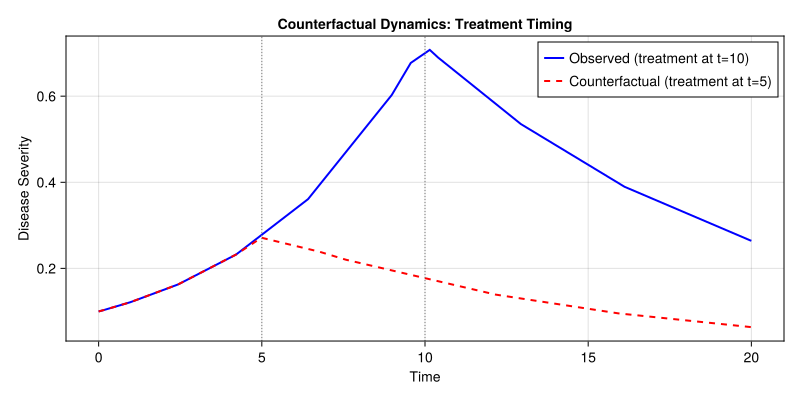
Here’s an example showing how to compute counterfactual trajectories for a specific unit:
# Find project root and include ensure_packages.jlproject_root =let current =pwd()while !isfile(joinpath(current, "Project.toml")) && !isfile(joinpath(current, "_quarto.yml")) parent =dirname(current) parent == current &&break current = parentend currentendinclude(joinpath(dirname(Base.active_project()), "scripts", "book_bootstrap.jl"))@auto_using OrdinaryDiffEq Random CairoMakieRandom.seed!(123)# Example: Treatment timing counterfactual# Observed: Treatment started at t=10# Counterfactual: What if treatment started at t=5?β =0.2# Disease progressionα =0.3# Treatment effectiveness# Step 1: Simulate observed trajectory (treatment at t=10)functiondisease_observed!(du, u, p, t)"""Disease model with observed treatment trajectory (treatment at t=10).""" X = u[1]# Treatment starts at t=10 A = t >=10.0 ? 1.0:0.0 du[1] = β * X - α * A * Xendu0_observed = [0.1] # Initial severitytspan = (0.0, 20.0)prob_observed =ODEProblem(disease_observed!, u0_observed, tspan)sol_observed =solve(prob_observed, Tsit5())# Step 2: Infer the "unit" (in this deterministic case, unit = initial condition)# For deterministic systems, the unit is fully determined by initial conditions# For stochastic systems, we'd need to infer the noise realisation# Step 3: Simulate counterfactual (same unit, different intervention: treatment at t=5)functiondisease_counterfactual!(du, u, p, t)"""Disease model with counterfactual treatment trajectory (treatment at t=5).""" X = u[1]# Counterfactual: Treatment starts at t=5 (earlier) A = t >=5.0 ? 1.0:0.0 du[1] = β * X - α * A * Xend# Same initial condition (same unit)u0_counterfactual = u0_observedprob_counterfactual =ODEProblem(disease_counterfactual!, u0_counterfactual, tspan)sol_counterfactual =solve(prob_counterfactual, Tsit5())# Compare outcomesfinal_observed = sol_observed.u[end][1]final_counterfactual = sol_counterfactual.u[end][1]println("Final severity:")println(" Observed (treatment at t=10): ", round(final_observed, digits=3))println(" Counterfactual (treatment at t=5): ", round(final_counterfactual, digits=3))println(" Improvement from earlier treatment: ", round((final_observed - final_counterfactual) / final_observed *100, digits=1), "%")
Final severity:
  Observed (treatment at t=10): 0.264
  Counterfactual (treatment at t=5): 0.064
  Improvement from earlier treatment: 75.9%
Figure 21.1: Counterfactual dynamics: comparing observed and counterfactual trajectories for a specific unit
21.3.3 Example: “What Would Have Happened If We Had Intervened Earlier?”
Question: For a specific patient, what would have happened if we had started treatment at time \(t_0\) instead of \(t_1\)?
Process:
Infer \(\mathbf{u}\) from observed trajectory (treatment started at \(t_1\))
Simulate counterfactual: same \(\mathbf{u}\), but treatment starts at \(t_0\)
Compare: counterfactual trajectory vs observed trajectory
21.4 Bounds and Partial Identification
When full counterfactual dynamics are not identified, we can still obtain bounds:
Non-parametric bounds: Range of possible counterfactual trajectories
Sensitivity parameters: How results change with assumptions about unobserved confounders
Uncertainty propagation: How uncertainty in \(\mathbf{u}\) affects counterfactual trajectories
21.4.1 Implementation: Bounds for Counterfactual Dynamics
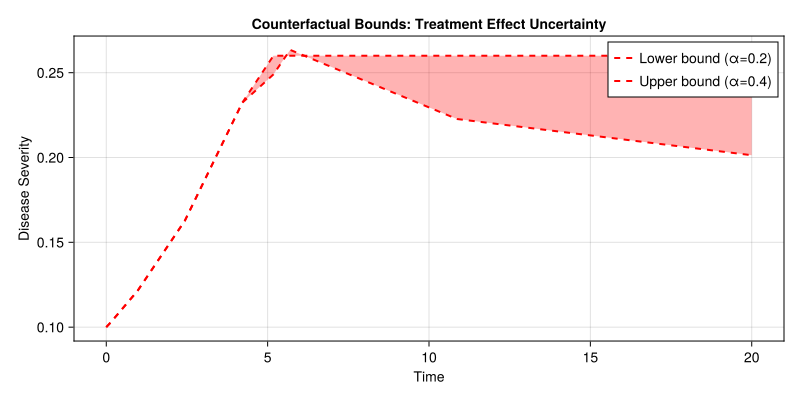
When we cannot fully identify counterfactual trajectories, we can compute bounds:
# Find project root and include ensure_packages.jlproject_root =let current =pwd()while !isfile(joinpath(current, "Project.toml")) && !isfile(joinpath(current, "_quarto.yml")) parent =dirname(current) parent == current &&break current = parentend currentendinclude(joinpath(project_root, "scripts", "ensure_packages.jl"))@auto_using OrdinaryDiffEq CairoMakie# Example: Counterfactual with uncertainty in treatment effect# We know treatment helps, but exact effect α is uncertain: α ∈ [0.2, 0.4]β =0.2# Disease progression (known)# Lower bound: α = 0.2 (weakest treatment effect)functiondisease_lower!(du, u, p, t)"""Disease model: lower bound (α = 0.2) for partial identification.""" X = u[1] A = t >=5.0 ? 1.0:0.0 du[1] = β * X -0.2* A * X # Lower bound on treatment effectend# Upper bound: α = 0.4 (strongest treatment effect)functiondisease_upper!(du, u, p, t)"""Disease model: upper bound (α = 0.4) for partial identification.""" X = u[1] A = t >=5.0 ? 1.0:0.0 du[1] = β * X -0.4* A * X # Upper bound on treatment effectendu0 = [0.1]tspan = (0.0, 20.0)prob_lower =ODEProblem(disease_lower!, u0, tspan)sol_lower =solve(prob_lower, Tsit5())prob_upper =ODEProblem(disease_upper!, u0, tspan)sol_upper =solve(prob_upper, Tsit5())println("Counterfactual bounds (final severity):")println(" Lower bound (weakest treatment): ", round(sol_lower.u[end][1], digits=3))println(" Upper bound (strongest treatment): ", round(sol_upper.u[end][1], digits=3))println(" Range: ", round(sol_upper.u[end][1] - sol_lower.u[end][1], digits=3))
Figure 21.2: Bounds for counterfactual dynamics when full identification isn’t possible
21.5 Stratum context
This chapter addresses Imagining in the Dynamical stratum: what alternative dynamic trajectories are possible? Counterfactual dynamics explore what would have happened for specific units under different interventions, given the same exogenous noise realisation.
21.6 Key Takeaways
Counterfactual trajectories: Alternative dynamic trajectories for specific units
Creative advance\(\mathbf{u}\): Same organism across alternative concrescences
Unit-level reasoning: Counterfactuals are for specific units, not populations
Bounds: Partial identification when full identification isn’t possible
Counterfactual dynamics bridge Dynamical and Observable: Use dynamic models to reason about alternative observable outcomes