Experiments are expensive (Chaloner and Verdinelli 1995; Ryan et al. 2016; Rothman et al. 2021). This chapter shows how to choose what to measure and what to perturb to answer causal questions efficiently, linking experimental design to CDM structure. This completes Imagining in the Observable stratum, designing optimal studies based on counterfactual reasoning and hypothesis generation.
32.2 The Experimental Design Problem
32.2.1 Question
“What should we measure and what should we perturb to learn about causal mechanisms?”
32.2.2 Constraints
Budget: Limited resources (time, money, subjects)
Ethics: Some interventions may be unethical
Feasibility: Some measurements may be impossible
Safety: Some perturbations may be dangerous
32.2.3 Goal
Maximise information about causal mechanisms subject to constraints.
32.3 Information-Theoretic Design
32.3.1 Mutual Information
Mutual information measures how much we learn about \(X\) from observing \(Y\):
\[
I(X; Y) = H(X) - H(X \mid Y)
\]
where \(H(\cdot)\) is entropy.
32.3.2 Optimal Design
Choose measurements/perturbations that maximise mutual information:
We can demonstrate how to choose measurements that maximise mutual information:
# Find project root and include ensure_packages.jlproject_root =let current =pwd()while !isfile(joinpath(current, "Project.toml")) && !isfile(joinpath(current, "_quarto.yml")) parent =dirname(current) parent == current &&break current = parentend currentendinclude(joinpath(dirname(Base.active_project()), "scripts", "book_bootstrap.jl"))@auto_usingRandom Distributions CairoMakieRandom.seed!(42)# Example: Choose between two measurement designs# Design 1: Measure X (high information about θ)# Design 2: Measure Y (lower information about θ)# True parameterθ_true =0.5# Design 1: X = θ + noise (direct measurement)σ1=0.1X = θ_true .+rand(Normal(0, σ1), 100)info_design1 =1/ σ1^2# Information ∝ 1/σ²# Design 2: Y = θ² + noise (indirect, nonlinear)σ2=0.1Y = θ_true^2.+rand(Normal(0, σ2), 100)info_design2 =1/ σ2^2* (2*θ_true)^2# Information depends on θ (lower for small θ)# Compare informationprintln("Information-theoretic design comparison:")println(" Design 1 (direct): Information ≈ ", round(info_design1, digits=2))println(" Design 2 (indirect): Information ≈ ", round(info_design2, digits=2))println(" → Design 1 provides more information about θ")println(" → Choose design that maximizes I(θ; Y)")
Information-theoretic design comparison:
  Design 1 (direct): Information ≈ 100.0
  Design 2 (indirect): Information ≈ 100.0
  → Design 1 provides more information about θ
  → Choose design that maximizes I(θ; Y)
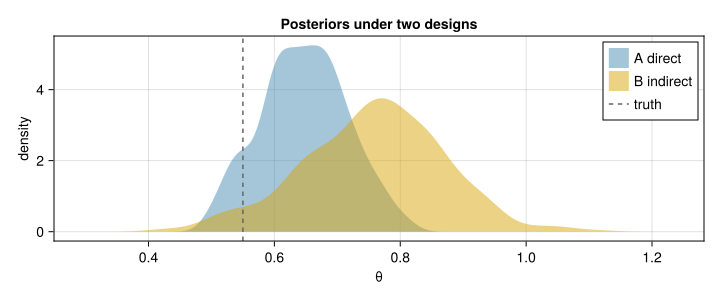
For a scalar parameter \(\theta\) and Gaussian experiments, expected information gain is (up to constants) the reduction in posterior variance (Chaloner and Verdinelli 1995). Compare two designs before collecting data:
Prior Var(θ)=1.0
Design A (direct):  Var_post≈0.0046  Δ≈0.9954
Design B (indirect): Var_post≈0.0124  Δ≈0.9876
Elapsed (both NUTS fits): 2.143 s
Posterior densities for \(\theta\) under direct (A) versus indirect (B) designs. Larger prior-to-posterior variance reduction favours design A.
Choose the design with larger expected variance reduction (here A). Adaptive designs repeat this calculation with the current posterior as the next prior.
Design determines what can be learned in practice.
Connection: Good designs make unidentifiable parameters identifiable, or improve precision of identifiable parameters.
32.4.2 Example: Unidentifiable Without Inputs
If parameters are unidentifiable without inputs, add inputs (perturbations) to make them identifiable.
32.4.3 Implementation: Design for Identifiability
We can demonstrate how to design experiments to make unidentifiable parameters identifiable:
# Find project root and include ensure_packages.jlproject_root =let current =pwd()while !isfile(joinpath(current, "Project.toml")) && !isfile(joinpath(current, "_quarto.yml")) parent =dirname(current) parent == current &&break current = parentend currentendinclude(joinpath(project_root, "scripts", "ensure_packages.jl"))@auto_using CausalDynamics Graphs# Example: Treatment effect may be unidentifiable without intervention# Graph: L → A → Y, L → Y (confounding)g =SimpleDiGraph(3)add_edge!(g, 1, 2) # L → Aadd_edge!(g, 2, 3) # A → Yadd_edge!(g, 1, 3) # L → Y# Check identifiability from observational dataadj_set_obs =backdoor_adjustment_set(g, 2, 3)is_identifiable_obs = !isempty(adj_set_obs)println("Identifiability check:")println(" From observational data: ", is_identifiable_obs ? "Identifiable":"NOT identifiable")if is_identifiable_obsprintln(" Adjustment set: ", adj_set_obs)elseprintln(" Problem: Unmeasured confounder or insufficient variation")end# Design solution: Randomise treatment (break L → A link)println("\nDesign solution:")println(" Randomised trial: Randomise A (breaks L → A link)")println(" → Treatment effect becomes identifiable")println(" → Can estimate E[Y | do(A=1)] - E[Y | do(A=0)] directly")
Identifiability check:
  From observational data: Identifiable
    Adjustment set: Set([1])

Design solution:
  Randomised trial: Randomise A (breaks L → A link)
  → Treatment effect becomes identifiable
  → Can estimate E[Y | do(A=1)] - E[Y | do(A=0)] directly
32.5 Design for Identification
To identify causal effects, designs should:
Provide variation: Different treatment levels
Control confounding: Randomisation or adjustment
Capture dynamics: Appropriate timing and frequency
Include perturbations: Inputs that help identify mechanisms
32.6 Adaptive Designs
Adaptive designs use information from previous observations to optimize future measurements:
Sequential design: Update design based on current knowledge
Multi-armed bandits: Balance exploration and exploitation
Active learning: Select most informative observations
32.6.1 Implementation: Adaptive Design
Here’s a simplified example of adaptive design:
# Find project root and include ensure_packages.jlproject_root =let current =pwd()while !isfile(joinpath(current, "Project.toml")) && !isfile(joinpath(current, "_quarto.yml")) parent =dirname(current) parent == current &&break current = parentend currentendinclude(joinpath(project_root, "scripts", "ensure_packages.jl"))@auto_usingRandom Distributions CairoMakieRandom.seed!(42)# Example: Sequential design for parameter estimation# Start with initial design, update based on observationsθ_true =0.5n_steps =5designs = []estimates = []# Initial design: uniform samplingcurrent_design ="uniform"for step in1:n_steps# Collect data under current designif current_design =="uniform"# Sample uniformly X =rand(Uniform(0, 1), 10)else# Focus on informative region (near current estimate)if step >1 est = estimates[end] X =rand(Normal(est, 0.1), 10) # Sample near current estimateelse X =rand(Uniform(0, 1), 10)endend# Observe outcomes Y = θ_true .* X .+rand(Normal(0, 0.1), 10)# Estimate parameter (avoid division by zero)# Use weighted least squares: Y = θ*X, so θ = mean(Y*X) / mean(X²) θ_est =sum(Y .* X) /sum(X.^2)push!(estimates, θ_est)push!(designs, current_design)# Update design: switch to focused sampling after initial explorationif step ==2 current_design ="focused"endendprintln("Adaptive design:")println(" Steps 1-2: Exploration (uniform sampling)")println(" Steps 3-5: Exploitation (focused sampling near estimate)")println(" Final estimate: ", round(estimates[end], digits=3), " (true = ", θ_true, ")")
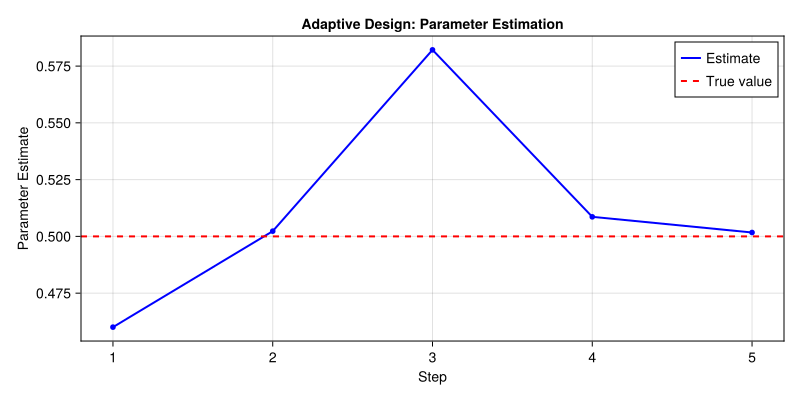
Adaptive design:
  Steps 1-2: Exploration (uniform sampling)
  Steps 3-5: Exploitation (focused sampling near estimate)
  Final estimate: 0.502 (true = 0.5)
Figure 32.1: Adaptive design: updating design based on observations
32.7 Study Design Types
Epidemiological research uses different study designs depending on the research question, available resources, and ethical constraints (Rothman et al. 2021). Understanding these designs helps choose appropriate designs for causal questions and recognise their strengths and limitations.
32.7.1 Experimental Designs
Randomised controlled trials (RCTs): Gold standard for causal inference
Cluster randomised trials: Randomisation at group level
Crossover trials: Each subject receives multiple treatments
32.7.2 Observational Designs
Cohort studies: Follow subjects over time
Case-control studies: Compare cases to controls
Cross-sectional studies: Single time point
32.8 Stratum context
This chapter addresses Imagining in the Observable stratum: what should we study next? Experimental design completes the Observable “Imagining” phase by showing how to design optimal studies based on counterfactual reasoning and hypothesis generation. This connects the strongest form of causal reasoning (counterfactual) with the most forward-looking activity (designing new studies).
32.9 Summary
Information-theoretic and Bayesian design choose measurements and perturbations that shrink posterior uncertainty about mechanisms (or make them identifiable). Adaptive designs iterate that choice; epidemiological study types constrain what is feasible in the field.
32.10 Further Reading
Chaloner and Verdinelli (1995): “Bayesian experimental design”
Ryan et al. (2016): “A review of modern computational approaches”
Rothman et al. (2021): Modern Epidemiology (4th ed.), comprehensive coverage of study designs
Chaloner, Kathryn, and Isabella Verdinelli. 1995. “Bayesian Experimental Design: A Review.”Statistical Science 10 (3): 273–304.
Rothman, Kenneth J., Sander Greenland, and Timothy L. Lash. 2021. Modern Epidemiology. 4th ed. Lippincott Williams & Wilkins.
Ryan, Elizabeth G., Christopher C. Drovandi, James M. McGree, and Anthony N. Pettitt. 2016. “A Review of Modern Computational Approaches for Optimal Experimental Design in Regression Models.”Journal of the Royal Statistical Society: Series C 65 (5): 779–816.