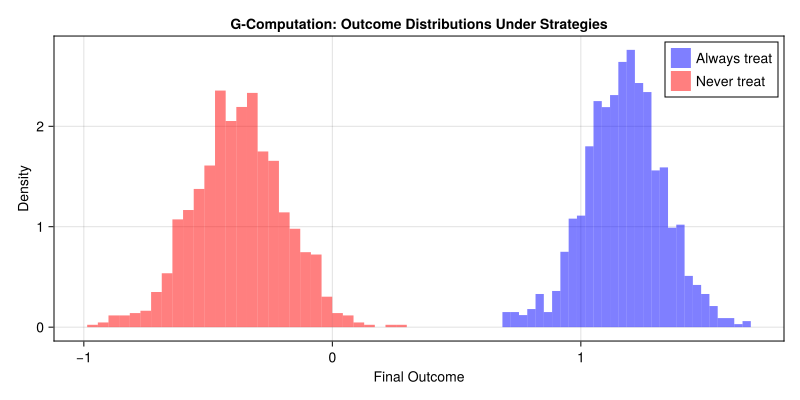
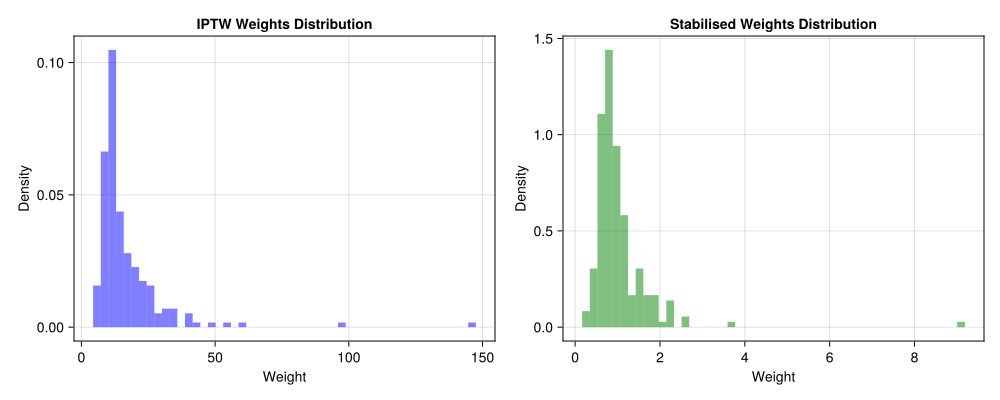
# Find project root and include ensure_packages.jl
project_root = let
    current = pwd()
    while !isfile(joinpath(current, "Project.toml")) && !isfile(joinpath(current, "_quarto.yml"))
        parent = dirname(current)
        parent == current && break
        current = parent
    end
    current
end
include(joinpath(dirname(Base.active_project()), "scripts", "book_bootstrap.jl"))

@auto_using Random Distributions CairoMakie

Random.seed!(42)

# Example: Time-varying treatment and confounder
# L_t: Disease severity (confounder)
# A_t: Treatment (depends on L_t)
# Y_t: Outcome (depends on L_t and A_t)

# Step 1: Fit models from observed data (simulated here for demonstration)
# In practice, these would be fitted from real data

# Confounder model: P(L_t | A_{t-1}, L_{t-1})
function fit_confounder_model(data)
    """
    Fit model for confounder evolution.

    NOTE: This is a simplified example. In practice, use flexible models
    (GLM with splines, random forests, Super Learner) to avoid misspecification bias.
    """
    # Simplified: L_t = α + β*A_{t-1} + γ*L_{t-1} + noise
    # In production, use flexible models (GLM with splines, machine learning)
    return (α=0.1, β=-0.2, γ=0.8, σ=0.1)
end

# Outcome model: E[Y_t | A_t, L_t, Y_{t-1}]
function fit_outcome_model(data)
    """
    Fit model for outcome expectation.

    NOTE: This is a simplified example. In practice, use flexible models
    to avoid misspecification bias in G-computation.
    """
    # Simplified: Y_t = α + β*A_t + γ*L_t + δ*Y_{t-1} + noise
    return (α=0.0, β=0.5, γ=-0.3, δ=0.7, σ=0.1)
end

# Simulate observed data (for demonstration)
n_subjects = 100
T = 5
data = []

for i in 1:n_subjects
    L = [rand(Normal(0.5, 0.2))]  # Initial severity
    A = Int[]
    Y = [rand(Normal(0.0, 0.1))]  # Initial outcome

    for t in 2:T
        # Treatment assignment (depends on L_{t-1})
        p_treat = 1 / (1 + exp(-2*(L[end] - 0.5)))  # Higher severity → more likely to treat
        push!(A, rand(Bernoulli(p_treat)))

        # Confounder evolution (depends on A_{t-1} and L_{t-1})
        L_new = 0.1 - 0.2*A[end] + 0.8*L[end] + rand(Normal(0, 0.1))
        push!(L, max(0, min(1, L_new)))  # Bound to [0,1]

        # Outcome (depends on A_t and L_t)
        Y_new = 0.5*A[end] - 0.3*L[end] + 0.7*Y[end] + rand(Normal(0, 0.1))
        push!(Y, Y_new)
    end

    push!(data, (L=L, A=A, Y=Y))
end

# Fit models
confounder_model = fit_confounder_model(data)
outcome_model = fit_outcome_model(data)

# Step 2: G-computation - simulate under treatment strategy
# Strategy: Always treat (A_t = 1 for all t)
function g_compute(strategy, confounder_model, outcome_model, n_sim::Int=1000)
    """
    Perform G-computation: simulate outcomes under a treatment strategy.

    Args:
        strategy: Function (t, L, Y) -> A_t (treatment at time t)
        confounder_model: Fitted model for confounder evolution
        outcome_model: Fitted model for outcome expectation
        n_sim: Number of Monte Carlo simulations

    Returns:
        Vector of final outcomes under the strategy
    """
    # Pre-allocate for performance
    outcomes = Vector{Float64}(undef, n_sim)

    for sim in 1:n_sim
        L = [rand(Normal(0.5, 0.2))]  # Initial severity
        Y = [rand(Normal(0.0, 0.1))]  # Initial outcome

        for t in 2:T
            # Treatment according to strategy
            # Strategy function takes (t, L, Y) where L and Y are current state vectors
            A_t = strategy(t, L, Y)

            # Simulate confounder under strategy
            L_new = confounder_model.α + confounder_model.β*A_t +
                    confounder_model.γ*L[end] + rand(Normal(0, confounder_model.σ))
            push!(L, max(0, min(1, L_new)))

            # Simulate outcome under strategy
            Y_new = outcome_model.α + outcome_model.β*A_t +
                   outcome_model.γ*L[end] + outcome_model.δ*Y[end] +
                   rand(Normal(0, outcome_model.σ))
            push!(Y, Y_new)
        end

        outcomes[sim] = Y[end]
    end

    return outcomes
end

# Strategy 1: Always treat
strategy_always_treat = (t, L, Y) -> 1.0

# Strategy 2: Never treat
strategy_never_treat = (t, L, Y) -> 0.0

# Compute expected outcomes
outcomes_treat = g_compute(strategy_always_treat, confounder_model, outcome_model)
outcomes_no_treat = g_compute(strategy_never_treat, confounder_model, outcome_model)

println("G-computation results:")
println("  E[Y | always treat] = ", round(mean(outcomes_treat), digits=3))
println("  E[Y | never treat] = ", round(mean(outcomes_no_treat), digits=3))
println("  Treatment effect = ", round(mean(outcomes_treat) - mean(outcomes_no_treat), digits=3))