6Structural Causal Models as Executable Mechanisms
Status: Draft
v0.6
6.1 Introduction
This chapter develops Structural Causal Models (SCMs) as executable mechanisms: a graph for structure, assignments for how each variable is generated, and exogenous noise for unit-level variation left outside the model (Pearl 2009; Peters et al. 2017). It builds on the graph patterns of Graph Theory and Causal Patterns. In these pages the working type is CausalDynamics.jl’s GraphSCM, with simulate_scm, do_intervention / apply_intervention, and compute_counterfactual for shared-\(U\) unit-level alternatives.
NotePackages implement the examples
This book’s framing is general: structure, dynamics, and observation for complex dynamical systems. Executable examples use a Julia stack, CausalDynamics.jl (identify), CausalTargeted.jl (estimate LMTP / mediation), DAGMakie.jl (display). The book is not package documentation; manuals and changelogs live in the repositories.
Code keeps standard Pearl / targeted-learning names (Intervention, do_surgery, backdoor_adjustment_set, run_lmtp_grid, …). Prose may use a sparse process gloss where it helps: prehension (taking account of), shared \(U\) as creative advance (Introduction), L3 alternative concrescences, and Chapter 9’s organism / environment / Markov blanket / society vocabulary for CDM scope (\(\mu\), \(\eta\), \(s\), \(a\), \(G\), \(F\)). Prefer ordinary words (observation, intervention, time step) elsewhere. Mapping: Concept Reference, Tables 4 and 8.
Package source as notation. Where the implementation is the explanation (graph surgery, path blocking, shared-\(U\) counterfactuals), chapters may show a short, syntax-highlighted excerpt from the owned packages in a “From …jl” callout, alongside executed API chunks. Those excerpts are curated under snippets/package-source/; they are not a substitute for the Documenter manuals.
\(U\): Exogenous (unobserved) variables capturing unmodelled variation and noise
\(F\): Structural assignments (functions) encoding the causal mechanisms
\(P(U)\): Distribution over exogenous variables
The graph \(G\) encodes which directed dependencies exist; the assignments \(F\) encode how parents and exogenous noise determine each endogenous variable.
6.3 Structural Assignments
Each endogenous variable \(X_i\) is assigned via a structural equation:
\[
X_i \coloneqq f_i(\mathrm{Pa}(X_i), U_i)
\]
where \(\mathrm{Pa}(X_i)\) are the parents of \(X_i\) in \(G\). The parent set specifies which variables enter the mechanism; \(f_i\) specifies the mapping.
6.4 Structural Equations as Mechanisms
Each structural equation encodes a causal mechanism from:
Parents \(\mathrm{Pa}(X_i)\) (direct causes under the assumed graph)
Exogenous noise \(U_i\) (unmodelled variation, stochasticity, or latent inputs)
6.4.1 Defining a graph and mechanisms
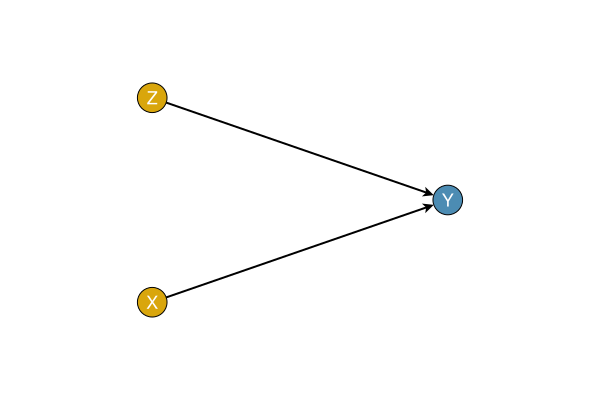
The toy DAG \(X \rightarrow Y \leftarrow Z\) has structural equations. In general,
\[
\begin{aligned}
X &\coloneqq U_X, \\
Z &\coloneqq U_Z, \\
Y &\coloneqq \beta_{XY}\, X + \beta_{ZY}\, Z + U_Y,
\end{aligned}
\]
and a numeric specialisation used below is \(\beta_{XY}=2\), \(\beta_{ZY}=3\).
# Find project root and include ensure_packages.jlproject_root =let current =pwd()while !isfile(joinpath(current, "Project.toml")) && !isfile(joinpath(current, "_quarto.yml")) parent =dirname(current) parent == current &&break current = parentend currentendinclude(joinpath(project_root, "scripts", "ensure_packages.jl"))@auto_using DAGMakie CairoMakie CausalDynamics Graphs# Nodes: 1 = X, 2 = Y, 3 = Zg_fork =SimpleDiGraph(3)add_edge!(g_fork, 1, 2) # X → Yadd_edge!(g_fork, 3, 2) # Z → Yfork_labels = ["X", "Y", "Z"]equations_fork =Dict{Int, Function}(1=> (u) -> u, # X := U_X3=> (u) -> u, # Z := U_Z2=> (x, z, u) ->2x +3z + u, # Y := 2X + 3Z + U_Y (parents sorted))scm_fork =GraphSCM(g_fork, equations_fork, Set{Int}())U_fork =Dict(1=>1.0, 2=>0.1, 3=>2.0)vals_fork =simulate_scm(scm_fork, U_fork)println("Factual values: X=$(vals_fork[1]), Y=$(vals_fork[2]), Z=$(vals_fork[3])")
Factual values: X=1.0, Y=8.1, Z=2.0
Toy SCM \(X \rightarrow Y \leftarrow Z\). Nodes \(X\) and \(Z\) have empty parent sets in \(G\); \(Y\) is determined by both parents and \(U_Y\).
GraphSCM stores a DiGraph, a Dict{Int, Function} of assignments (parent values in index order, then that node’s exogenous draw), and an optional set of exogenous node indices. simulate_scm(scm, U) evaluates in topological order for one fixed realisation of \(U\).
6.5 Modularity Principle
Under intervention \(do(X_i = x)\), the assignment for \(X_i\) is replaced by a constant:
\[
X_i \coloneqq x \quad \text{(instead of } f_i(\mathrm{Pa}(X_i), U_i)\text{)}
\]
All other mechanisms remain unchanged. That modularity of causal mechanisms is the local-change semantics of \(do(\cdot)\)(Pearl 2009): the intervened node no longer depends on its natural parents, but descendants still depend on its fixed value.
6.5.1 Implementation: modularity under intervention
NoteFrom CausalDynamics.jl
The modularity principle above is not only prose: apply_interventionis that local change. Incoming edges to the intervened node are removed, and its structural equation becomes a constant assignment. Other equations are left untouched.
# packages/CausalDynamics.jl/src/scm/interventions.jl (excerpt)functionapply_intervention(scm::GraphSCM, intervention::DoIntervention) var = intervention.variable val = intervention.value node = var isa Int ? var :throw(ArgumentError("Symbol-based variable resolution not yet supported for GraphSCM. Use integer node indices.", ))# Mutilated graph: remove all incoming edges to the intervened node new_graph =copy(scm.graph)for parent incollect(Graphs.inneighbors(new_graph, node)) Graphs.rem_edge!(new_graph, parent, node)end# Replace only this node's equation with a constant new_equations =copy(scm.equations) new_equations[node] = (args...) -> valreturnGraphSCM(new_graph, new_equations, scm.exogenous)end
The book’s examples call this API; the excerpt is the mechanism itself. Full reference: CausalDynamics docs.
On the fork, \(do(X = 5)\) removes \(X\)’s natural assignment (and any incoming edges) while \(Y\)’s equation still uses the fixed \(X\) and \(Z\):
scm_do =apply_intervention(scm_fork, do_intervention(1, 5.0))vals_do =simulate_scm(scm_do, U_fork)println("Under do(X = 5): X=$(vals_do[1]), Y=$(vals_do[2]), Z=$(vals_do[3])")println("Parents of X after surgery: ", collect(inneighbors(scm_do.graph, 1)))println("Y still has parents X and Z: ", has_edge(scm_do.graph, 1, 2) &&has_edge(scm_do.graph, 3, 2))
Under do(X = 5): X=5.0, Y=16.1, Z=2.0
Parents of X after surgery: Int64[]
Y still has parents X and Z: true
6.6 Shared-\(U\) counterfactuals
Interventional queries ask what happens in a population under \(do(\cdot)\), typically averaging over \(U\). Unit-level counterfactuals hold the same \(U\) fixed and change only the intervention (Pearl’s abduction–action–prediction; creative advance held constant in the process gloss of Table 8). CausalDynamics exposes that as compute_counterfactual.
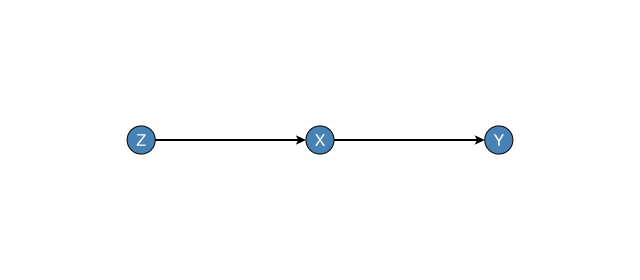
The chain \(Z \rightarrow X \rightarrow Y\) makes the arithmetic transparent:
g_chain =DiGraph(3)add_edge!(g_chain, 1, 2) # Z → Xadd_edge!(g_chain, 2, 3) # X → Yequations_chain =Dict{Int, Function}(1=> (u) -> u,2=> (z, u) -> z + u,3=> (x, u) ->2x + u,)scm_chain =GraphSCM(g_chain, equations_chain, Set{Int}())U_chain =Dict(1=>1.0, 2=>0.5, 3=>-0.3)result =compute_counterfactual(scm_chain, do_intervention(2, 10.0), U_chain)println("Factual Y = ", result.factual[3])println("Counterfactual Y under do(X = 10) = ", result.counterfactual[3])println("Same U_Y in both worlds: exogenous draw for node 3 held at ", U_chain[3])
Factual Y = 2.7
Counterfactual Y under do(X = 10) = 19.7
Same U_Y in both worlds: exogenous draw for node 3 held at -0.3
Factual \(Y = 2(1.0 + 0.5) + (-0.3) = 2.7\); under \(do(X = 10)\) with the same \(U\), \(Y = 2\cdot 10 + (-0.3) = 19.7\). Chapter 7 develops the twin-network reading of this construction.
Chain \(Z \rightarrow X \rightarrow Y\) used for the shared-\(U\) counterfactual. Intervention \(do(X = 10)\) mutilates incoming edges to \(X\) while \(Y\) remains a child of \(X\).
6.7 Linear SCMs and matrix representations
When structural equations are linear, they can be written in matrix form, connecting the graph of Chapter 3 to executable assignments. For a static linear SEM (Peters et al. 2017)
\[
\mathbf{X} = B\mathbf{X} + \mathbf{U},
\]
with \(B_{ij}\) the structural weight on \(X_j \rightarrow X_i\). Under a topological order \(B\) is strictly triangular; its support matches the edge set of \(G\). Time-indexed linear dynamics (Part II) use related sparse transition maps. Matrix analysis and sparse factorisation are the usual algebraic companions (Strang 2016; Horn and Johnson 2013; Golub and Van Loan 2013; Davis 2006).
Sparse dependencies. In most real systems each variable depends on only a small subset of others. Missing edges imply structural zeros in \(B\); present edges mark the only non-zeros that need storing or estimating.
6.7.1 Algebraic path labels, then numbers
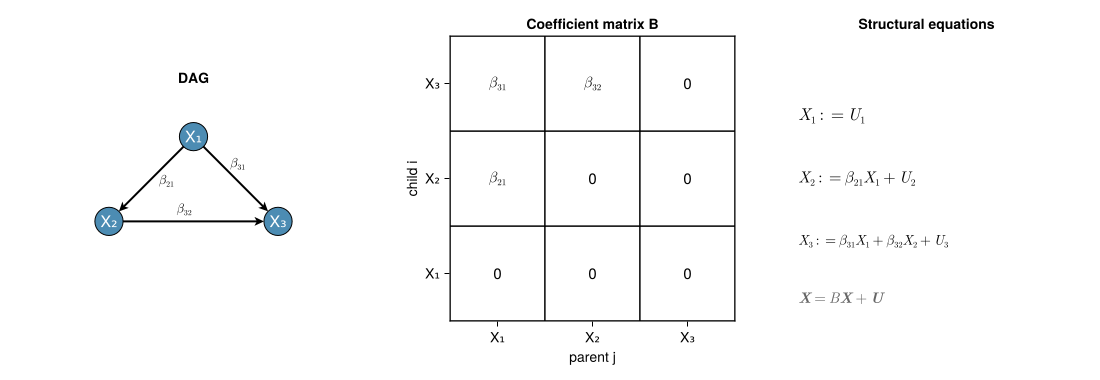
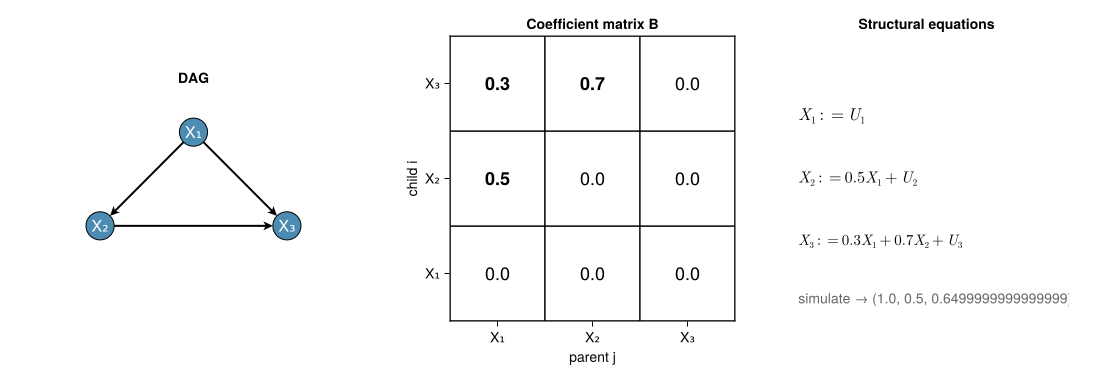
The confounding DAG \(X_1 \rightarrow X_2 \rightarrow X_3\), \(X_1 \rightarrow X_3\) is the same bridge as in Chapter 3: first structural path coefficients, then a numeric instance that GraphSCM can simulate.
General linear confounding / mediation triangle: structural path coefficients on the DAG, symbolic \(B\), and assignments. \(B_{ij}\neq 0\) means \(X_j\rightarrow X_i\)(Peters et al. 2017).
Numeric instance \(\beta_{21}=0.5\), \(\beta_{31}=0.3\), \(\beta_{32}=0.7\), executed by GraphSCM / simulate_scm for \(U=(1,0,0)\).
6.7.2 Executable SCMs at scale: GraphPPL and latent interfaces
For high-dimensional observations (e.g. MIRS spectra Y), the SCM is still defined over structural nodes, but the inference layer should not duplicate thousands of wavenumbers inside a PPL. One workable pattern (AgeSCM; Chapters 28b and 30):
Identification / graph: DAG and adjustment sets (CausalDynamics helpers such as prepare_for_rxinfer, prepare_for_tmle).
Encoder: e.g. Flux ẑ = g(Y; nuisances residualised).
Probabilistic programme: GraphPPL / RxInfer @model on ẑ and the outcome of interest, not on raw Y (live wiring in Chapter 30; poultry ATE in Chapter 5).
Interventions remain structural; the encoder is a learned observation mechanism whose outputs feed the PPL.
6.8 Stratum context
This chapter addresses doing in the Structural layer: interventions as local changes to a data-generating process while other mechanisms stay fixed. Identification of what can be learned from data is the subject of Chapter 5; time-indexed CDMs extend the same modular idea across occasions in Part II and Chapter 28.
6.9 Summary
An SCM pairs a DAG with structural assignments and exogenous noise. GraphSCM makes that tuple executable: simulate_scm settles one unit for fixed \(U\), apply_intervention implements modularity by mutilating parents of the intervened node, and compute_counterfactual compares factual and alternative outcomes under shared \(U\). Linear maps \(\mathbf{X}=B\mathbf{X}+\mathbf{U}\) mirror the adjacency pattern with structural path coefficients on the edges; at high dimension, keep the PPL on a low-dimensional structural interface rather than raw high-dimensional measurements.
Peters et al. (2017): Elements of Causal Inference — SCM framework
Chernozhukov et al. (2024): Applied Causal Inference Powered by ML and AI, Chapters 6–7 (linear and nonlinear SEMs with DAGs; intervention and counterfactual graphs)
Chernozhukov, Victor, Christian Hansen, Nathan Kallus, Martin Spindler, and Vasilis Syrgkanis. 2024. Applied Causal Inference Powered by ML and AI. https://doi.org/10.48550/arXiv.2403.02467.